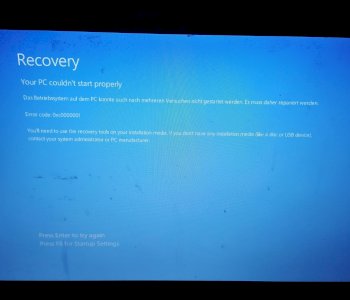
Shortens the life of an SSD due to insufficient free memory?
On my notebook came the ad:
"Low disk space - SSD life is reduced by less than 25% free space".
The display came from an application of the manufacturer of the notebook (MSI).
Meanwhile, I've made room again, but the thesis is not out of my head.
The question for you:
Is this statement true or is it nonsense?
The statement is basically correct.
A lot of free memory on the SSD ensures that the write access controller has many different sectors available and wear out.
With only a small amount of free memory, which is always described by temporary files, a few sectors are losing their power.
However, you do not have to worry so much, tests have shown that SSDs fail at the earliest after 10 years due to wear.
Which does not mean that your own SSD will last so long. I had z.b. Already a failure after 4 years and about 14TB written.
This is a popular medium in addition to the exploding operating systems. To sell new hardware or memory.
Of course, the life of the hard drive when it is vollgekneult shortens. As burninghay already wrote. However, not significant. In other words, an overflowing ssd stretches say the hoofs after 10 years, a not so full after 10 years and 3 months.
these are just examples…
The lifetime of an SSD depends on the number of write accesses. The problem is that data can only be written in blocks at a time, so it is usually necessary to write significantly more data than was actually logically changed. In addition, if SDS space is limited, many more blocks need to be reorganized to make room, adding to the number of write options. In practice, it has been shown that with write-intensive use from about 25% free space, the number of write accesses significantly reduced and thus increases the life of the SSD. In this respect, the note of the notebook manufacturer is quite correct. Some SSDs use additional storage space reserved for disk space management (over provisioning) for performance enhancement. With some SSDs you can determine this memory space yourself.
The number of write accesses of different applications can be determined using a tool such as Procmon from Sysinternals. You will be surprised how often e.g. The browser Google Chrome writes to your SSD. The remaining life of your SSD can be viewed by a tool like SSDLife Free. Since I no longer have Google Chrome written to my SSD, the estimated remaining lifespan has more than tripled:
the lifetime of an SSD depends on the number of write accesses. The problem is that data can only be written in blocks at a time, so it is usually necessary to write significantly more data than was actually logically changed. In addition, if SDS space is limited, many more blocks need to be reorganized to make room, adding to the number of write options. In practice, it has been shown that with write-intensive use from about 25% free space, the number of write accesses significantly reduced and thus increases the life of the SSD. In this respect, the note of the notebook manufacturer is quite correct. Some SSDs use additional storage space reserved for disk space management (over provisioning) for performance enhancement. With some SSDs you can determine this memory space yourself.
The number of write accesses of different applications can be determined using a tool such as Procmon from Sysinternals. You will be surprised how often e.g. The browser Google Chrome writes to your SSD. The remaining life of your SSD can be viewed by a tool like SSDLife Free. Since I no longer have Google Chrome written to my SSD, the estimated remaining lifespan has more than tripled:
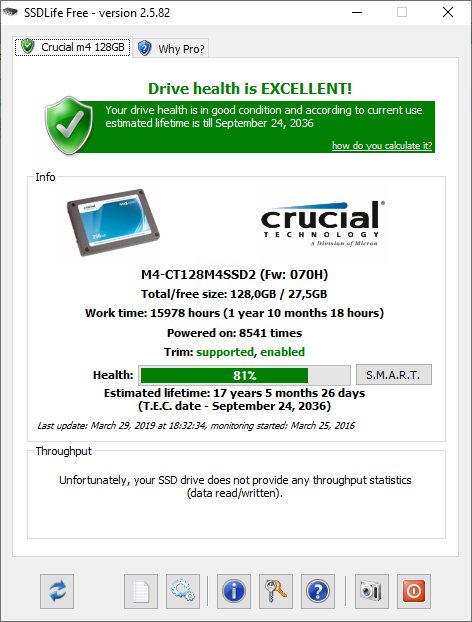
About 3 years old SSD after reduction of browser write access