I got a used gaming laptop. Unfortunately, it just goes out with graphics-intensive things, although it sometimes also happens when booting and rarely when surfing. I've tried almost everything.
I bought a new original power supply
New thermal paste and cooler clean (temperatures are good)
The graphics card expanded (you can actually use it)
Ram and ssd changed
Windows new on it
Battery disconnected (broken anyway)
I have the feeling that it could be something with the power supply, because you need more power when booting and gaming.
With the GPU it goes off after 20 seconds with the furmark, with the internal one it runs for at least 15 minutes (then I just turned off the furmark)
It looks like the graphics card, but the crashes also occur if it is not installed, e.g. Only when starting a game
It's really complicated and thank you in advance for your help
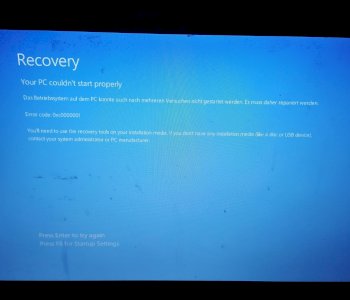
It would be helpful if you could give some information such as the temps of the GPU or hardware you have there or what kind of device it is
It's a msi gt72 with an i7 6700hq, gtx 970m, 8 gb ram. The temps before the crash are often around cpu 65-75 and gpu around 70. So really not much for a laptop. In a cinebench, however, the cpu goes, for example. Also a little higher
I lean very far out of the window and claim that it is not the GPU, since even removing the graphics card manually does not actually lead to a system crash.
To me that sounds like either a problem with the mainboard or with the CPU.
It would be interesting to know whether the laptop crashes even with complex programs without a graphical user interface, that is, when only the CPU is used.
So the cinebench r20 runs e.g. Without any problems.
Then maybe you could be right that it's the power supply. Take a look at what power your power supply unit brings and what power the individual components have. The device may then switch off due to overload.
I already bought a new power supply unit because the power supply unit was also my guess⦠Even with the new power supply unit, it doesn't work. My guess is that it has something to do with electricity, but it's in the laptop itself. Unfortunately, I have no idea about that. Whether some capacitor is defective or somehow a voltage converter that could cause something
Let's say you've bought a new power supply unit that delivers 400 watts, for example, but your components need a total of 500 watts, for example. Then the power supply unit may be flawless, but will still not deliver enough power. This is what I was getting at.
If it is actually due to a capacitor or voltage converter, then I think you can forget about it. Repairing small parts on mainboards or other individual components is usually not worthwhile.
You could try trying each component individually on a different computer. Then you can narrow down the problem.