Windows 7 deletes linux?

va
14

Moin Moin together,

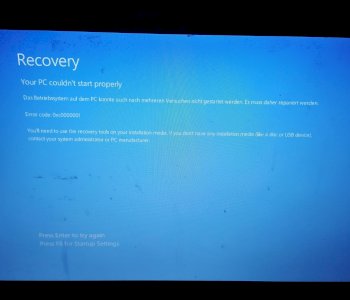
I wanted to install Linux on my laptop. When the installation was finished I restarted the computer because I was supposed to do this. Now, however, no menu or something opened where I could choose anything, instead Windows simply started and ran chkdsk independently. After that, my computer restarted and I still couldn't start Linux. But Windows 7 worked normally again as if nothing had happened. My question is now that I have to press any key to enter this selection menu or whether it should open automatically. I'm also wondering whether Windows Linux has been deactivated via chkdsk or even uninstalled. Can someone enlighten me a bit on the subject.

mo

You will have installed the boot loader, which should actually start both systems (Windows7 and your Linux), on a different hard drive.

Change the boot order in the BIOS.

fi

Windows can't delete Linux. You made a mistake with the boot manager. Other hard drive wrong partition information etc. Boot from linuxCD or stick and look. Oh yes Windows does not see the Linux partitions. It's the other way around Linux sees Windows partitions.

mo

See you have a laptop, they usually only have a hard drive.

So my answer is not that helpful.

Only an installation error could have occurred.
Why did you choose Ubuntu (Linux Lite is an offshoot)?

va

So during the installation I was told nothing about an error, but rather that the installation would have been successful. And how was it with the boot loader? For me the boot loader Grub 2.0 starts as soon as I boot from the Linux setup stick.

mo

Grub is a boot loader that can boot different operating systems. Then he has a selection menu.

If you boot from the stick, does Windows also appear there?

When you tried to install, were you asked to make space for Linux on the hard disk? Did you have a partition for it before?

If not, then I have the guess that you have not installed Linux at all and the stick contains a Linux live system.

va

OK Good

I don't see a selection menu, only a kind of console opens for me, in which I can type in commands with "grub>" in front of it.
No, when I boot from the stick, Windows is not displayed.
No I didn't, I could only set how much storage space I want to make available to Linux. The standard was 90GB. Before I had no partition for it, the Linux installer created a 3rd and 4th partition myself.
Yes, the stick has a Linux Live system, but you can also choose the option that the Linux should install, which I did.

mo

If you see grub> there's obviously a first part of grub in the MBR (Master Boot Record) of the device from which you are booting. There should be a link pointing to a newly created partition. That is obviously missing.
I never managed to fix that.
It looks to me as if the Linux installation tools had written this 1st part on the USB stick. I'm not aware of openSuSE or Manjaro that an installation medium starts with grub.
I would reinstall the stick with an ISO prepare.

The 2 new partitions are ok.

Another question: does your laptop have the old BIOS or already an EFI?

va

I have no idea what kind of bios my laptop has, I only know that it is a Phoenix SecureCoreTiano setup… At least on top

va

One more thing when I enter the command boot in grub it says that you have to load the kernel first, can you maybe say something about it or rather not?

mo

This is what I already wrote, the kernel is in the 2nd part of grub and this connection to one of the Linux partitions is missing.

If you have an old BIOS, it should be recognizable by the fact that a bar with… BOOT EXIT (or something similar) can be found at the top, an EFI BIOS has more color

Ev

In the disk management under Windows you can see whether Linux has been installed. Then unknown partition appears.

If this unknown partition is deleted, it may be that Windows can no longer be started.

va

Like now I see in the disk management a partition that has neither a drive letter nor a file system (apparently). Is this this unknown partition?

Ev

This is this unknown partition.

Na

Do you have your own partition for Linux?

Then you probably made the classic mistake and dug in the MBR of the Linux partition (e.g. Sda2) installed. So that grub starts at boot, it must be installed in the MBR of the hard disk (sda).

For the previous procedure, see here: https://wiki.ubuntuusers.de/GRUB_2/Reparatur/

under "Repair using desktop CD"