I bought a laptop that has Linux installed. When I wanted to install Windows (via usb stick) I deleted all partitions and canceled the installation because I had the wrong key.
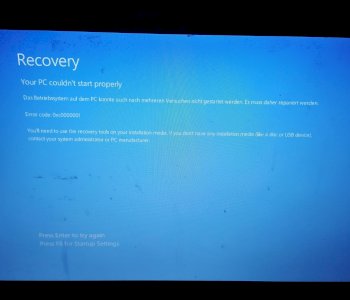
If I now start the laptop (with win usb stick) is directly after the logo "no bootable device"
Now 2 questions: is it going on? And how does it go on?
Of course you will still buy the right key, if there's a solution, thank you!
You still have a bootable USB stick, possibly still set in the BIOS, that it is first invoked and started. Otherwise, I do not understand why you did not share the HD, one half for the old operating system, the other half for the new one. There are plenty of instructions, even on youtube
Unfortunately, I can't change the boot priority because nothing is displayed
F8, while the bios counts up, generally calls the boot menu…
Unfortunately, no boot possibilities are displayed, neither in the Bios nor in the boot manager. I can do it a maximum with a reinstall of win on the stick.
Start again and format the hard disk. Then start the installation. You can get the key within 30 days. Until then, the system will run.
Why would you prefer to stay with Linux? XD
You can enter the BIOS to change the boot priority even if nothing is displayed. Usually you have to press the ENTF, F10 or F12 keys before the logo disappears.
However, if you have a "UEFI BIOS" you can sometimes set it to only be reached via the operating system. Then you have excluded yourself. But something is always - look into the instructions of your laptop (in self-built computers, it would be the motherboard), if necessary Googling for the name.
How did you booted the Windows stick? About the still existing boot loader of Linux?
If nothing works at all: Remove the hard disk and set it up on a friend's PC (partition, format and at least set up the repair partition). Depending on the hard drive / SSD, this of course requires the right adapter.
Yes, I've set that up on Linux. I still have a second pc. Is it easy to remove the ssd (m.2) from the laptop?
How easy the expansion is depends on the laptop - it's usually easy. The manual or, in such a case, Youtube videos on the laptop model usually help further. Of course, the second PC then needs a free m.2 slot (on the board or as an adapter)
I got it solved. Everywhere it was written that one should format with FAT32. With NTFS or so it went.
So Win 10 did NOT tell you that you should take the age-old Fat 32
https://www.easeus.de/partitionieren-tipps/wie-kann-man-fat32-in-ntfs-unter-windows-10-konvertieren.html
Anyway: Congratulations on the solution!
So many "experts" on forums suggested Fat 32, so I thought that would be okay
Become an expert myself; -9