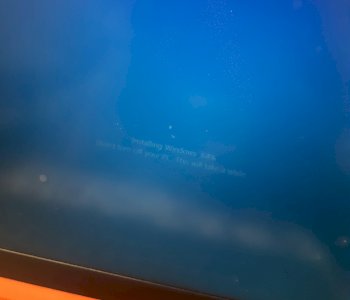
Since my Windows is broken on my PC, I want to delete Windows from my SSD. For this I would need my PC currently not working. Can I erase my SSD with a laptop or something like that?
Linux USB stick and disk format.
How do I connect my ssd to my laptop?
That's in it?
USB with Linux, plug in USB, boot PC and F12 / F2 / depending on the… Press, select the USB in the BOOT menu, wait until the Linux is up, gparted start, with gparted select the plate and flatten.
The USB can access the SSD if the Linux recognizes it, which it should normally do. So you can safely install the SSD.
My computer is not broken my laptop
That does not change the functioning?
USB to PC and boot from USB.
Or can't you even turn it on?
How do you know that your hard drive is broken?
Do you come into the BIOS or get other information about the PC?
If the boot menu comes, or it does not turn on at all.
If the former is the case, it has disassembled your windoof and the above description should solve the problem.
The second is the case, it is not on your hard drive, but on the BIOS or other hardware components in your PC.
Have gparted started what now how do I delete it
First, be aware that all your files on the SSD are gone after that.
Then ALL is deleted.
Little idea on the edge: https://www.cnet.com/...ssd-drive/
Otherwise, you just choose your SSD in the upper right of the Device Manager, should be / dev / nvme0n1 or so called.
If there's / dev / sdxY (where x is any letter such as a, b, … Is and Y stands for any number), then your USB is selected, which would not be so clever.
Here, then, set the SSD as the target, and then gradually select the displayed partitions, unmount (right-click) and then delete.
Save and confirm the changes to make the SSD flattened, i. The data is deleted and you have an unallocated partition with unallocated file system.
Then create a new partition table on GPT (?) And a new partition with full space as the primary partition with any partition name and any name and select FAT32 or exFAT as file system if needed, and write the changes back to the disk.
Then simply shut down the Linux and then reinstall Windows / Linux.
That should be the way to go in my opinion.
Just be clear as I said that the data then only specialists (if any) can bring back.
So if you are unsure about the contents of your SSD, rather a backup of the user directory from Linux to an external hard drive or a USB stick.
Just remove this again, before it goes to the canned, otherwise you could accidentally delete the backup.
Thank you